
Millimetre graph paper is for measuring and drawing to scale, squared paper is for writing, doing sums and organizing ideas in columns, and lined paper is for writing straight or practising handwriting (and, in its music version, for writing sheet music). That's the short answer. You can print all three at home on an A4 sheet with an ordinary printer, as long as you set the scale correctly.
The question usually comes up when you need a specific sheet and don't have a notebook to hand: your child has handwriting homework, you want to draw a plan of the living room before moving the sofa, or you feel like keeping track of your spending by hand. Instead of buying a whole pad, you print just the sheets you need.
Here is how each type differs, what sizes exist, what to use them for at home, and how to print them so that a millimetre really measures a millimetre.
What's the difference between graph, lined and squared paper
All three are sheets with printed lines, but each has a different function:
- Millimetre graph paper: a very fine grid with a line every millimetre, a bolder one every 5 mm and a thicker one every centimetre. It is a measuring tool.
- Squared paper: larger squares, normally 4 or 5 mm. It is a sheet for writing and organizing, not for measuring precisely.
- Lined paper: horizontal lines that guide your writing. It includes single ruled lines, double-line paper, Montessori-style lines and the music staff.
If you are going to measure, choose graph paper. If you are going to write and organize, squared paper. If the shape and size of the letters is what matters, lined paper.
Printable millimetre graph paper: what it is for
Printable millimetre graph paper is the most technical of the three. At school it is used for graphs of functions and data, but at home it is also very practical.
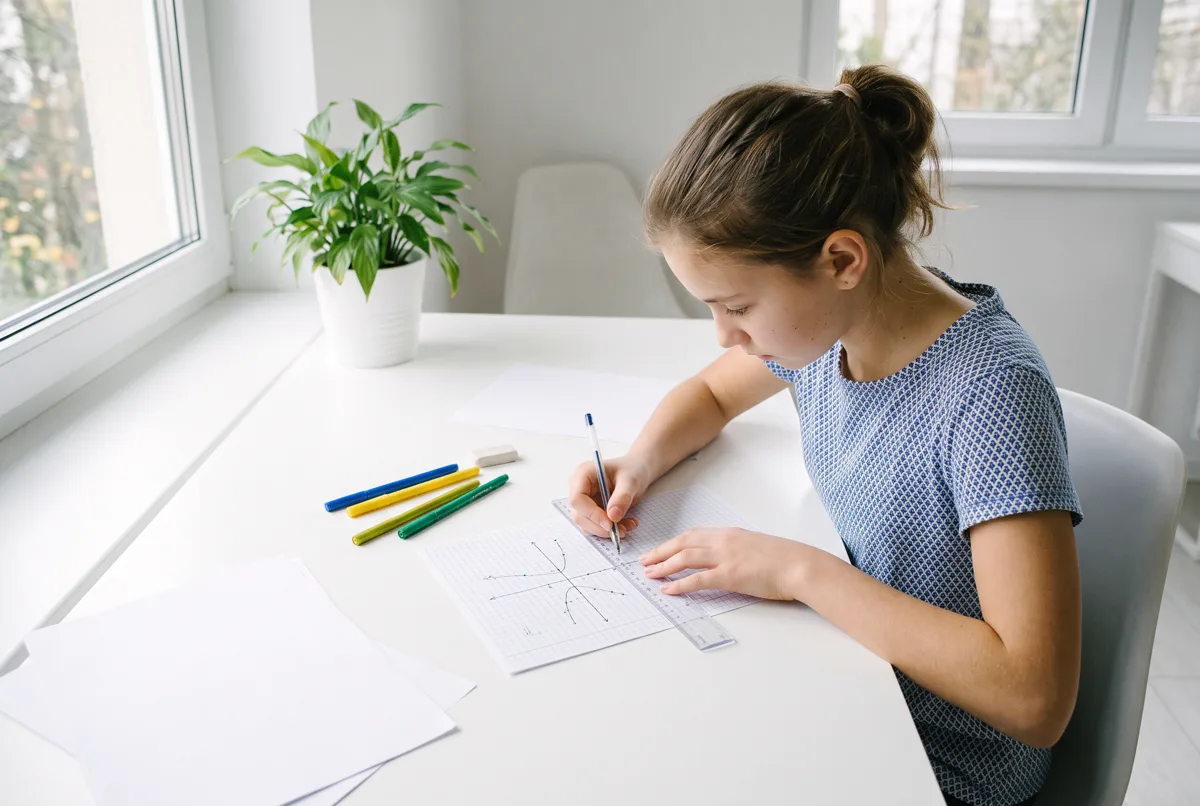
Uses of graph paper at home
- Scale plans: drawing a room to see whether a piece of furniture will fit before you buy it.
- Simple patterns: sewing, crafts, curtains or cushion covers.
- Tracking charts: how much you save each month or how your electricity bill changes.
- Embroidery and cross-stitch designs: each little square can be one stitch.
- Maths, physics or technical drawing homework.
Example: a plan of your living room at 1:50 scale
At 1:50 scale, every centimetre on the paper equals 50 cm in real life. A living room of 5 x 4 metres takes up a rectangle of 10 x 8 cm on the sheet, which fits easily on an A4. The steps:
- Measure the room with a tape measure and note down the length, width, doors and windows.
- Divide each measurement by 50 and transfer it to the paper in centimetres.
- Draw the outline following the thick centimetre lines.
- Cut out the furniture at the same scale from another sheet of graph paper: a 2-metre sofa will be 4 cm.
- Move the cutouts around until you find the layout you like.
That way you can try out several options without dragging a single piece of furniture.
Squared paper: the most versatile for getting organized
Squared paper is the classic in Spanish notebooks. The 4 mm grid is the most common; the 5 mm one leaves a bit more room, and for the youngest children there is a large grid of 6 or 8 mm.
What squared paper is for
- Sums and maths: each digit in its own square, so the columns stay aligned.
- Handmade lists and tables: the shopping list by section, a chore rota or a spending log.
- Homemade planners and journals: you mark out columns for the days without needing a ruler.
- Outlines and notes: the grid helps you indent and keep margins even.
- Geometric drawings and games: battleships, mazes or pixel art with the kids.
If you keep the household accounts by hand, a squared sheet lets you make columns for income, fixed costs and variable costs without them drifting out of line. If you want a template to start with, here we explain how to make a monthly family budget, with an example.
That said, if you'd rather not draw columns every month, a sheet that is already laid out for the week or for spending saves you that step, and you can also combine it with your squared sheets.
Lined paper: handwriting, writing and music
Lined paper has horizontal lines to guide your writing. In Spain the term for it is used for two different things, so it helps to know which one you are looking for.
Lined paper for writing and handwriting
- Single ruled lines: one line per row. For letters, journals and adult notes.
- Double-line paper: two lines per row that mark the height of small letters. Widely used in the first years of primary school.
- Montessori-style lines: four lines that separate the zone for tall letters, the middle zone and the letters that drop below the line, like g or p. Ideal for starting to write.
- Grid-and-lines ruling: combines a grid with guide lines, common in Spanish school notebooks.
- Slanted handwriting lines: with diagonal lines for practising lettering or copperplate script.
Music paper or staff paper
Music paper has groups of five lines, called staves, for writing notes. An A4 sheet usually fits between 10 and 12 staves. It is useful if someone at home is studying music, copying songs for the school recorder or wants to jot down chords.
Practising handwriting slowly, line by line, also has something of a quiet routine about it that many people find helps them slow down at the end of the day. If you like those small pauses, at home and unhurried, there are more ideas along those lines.
Which one to choose depending on what you are doing
This table sums up which sheet suits each common situation:
| What you want to do | Type of paper | Recommended size |
|---|---|---|
| Plan of a room or a pattern | Millimetre graph paper | 1 mm, with lines at 5 mm and 1 cm |
| Savings chart or data graph | Millimetre graph paper | 1 mm |
| Sums, budget, lists | Squared paper | 4 or 5 mm |
| Handmade planner or journal | Squared paper | 5 mm |
| Children starting to write | Montessori-style or double-line paper | Large lines, 3 to 4 mm per zone |
| Letters, personal journal | Single ruled lines | Rows of 7 to 8 mm |
| Sheet music | Music paper | 10 to 12 staves per sheet |
| Cross-stitch or pixel art | Millimetre graph or squared paper | Depends on the size of the design |
If you can't decide between two, print one sheet of each and try them. That is the advantage of doing it at home.
How to print them at home so the measurements come out exact
The most common problem with graph paper is that it comes out shrunk: the printer reduces the page so it fits within the margins, and the millimetres end up measuring 0.95 mm. In an accounts notebook it doesn't matter, but in a scale plan it does. Follow these steps:
- Download the template as a PDF in A4 size, not US Letter, which is the American format and slightly different.
- Open the print dialog and look for the scale or size option.
- Choose "Actual size" or 100% scale. Turn off "Fit to page" or "Shrink oversized pages".
- Check that the selected paper is A4 and that the orientation matches the template.
- Print a single test sheet.
- Measure 10 cm of grid with a ruler. If it comes out at exactly 10 cm, you can print the rest.
If you print from your phone, the scale option is sometimes hidden in a "more options" menu; we explain it in how to print from your phone step by step.
Tips for using less ink and paper
- Look for templates with light grey or soft blue lines: they use less ink and get in the way less when you write.
- For squared and lined paper, draft mode or ink-saving mode is usually enough.
- Print on both sides if you are making a notebook; here is how to print double-sided at home without getting it wrong.
- 80 gsm paper (grams per square metre) works for almost everything. If you are going to use markers or light watercolour, go up to 90 or 100 gsm. There are more details in this guide to types and sizes of paper for printing at home.
Ideas for getting the most out of them in your organization
Once you have the sheets, you can turn them into something more useful than a loose pile in a drawer:
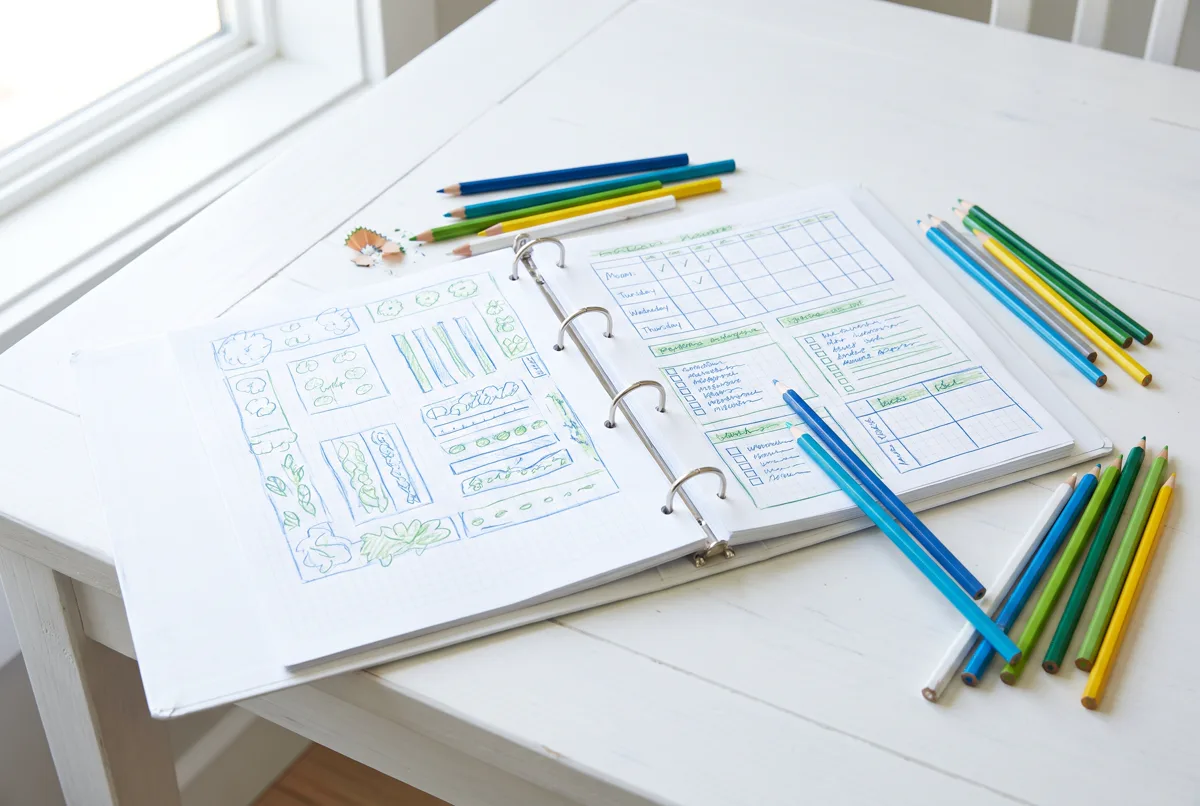
- Custom notebook: mix squared sheets for accounts, lined sheets for notes and a few graph sheets for plans. Afterwards you can bind them by following the steps for binding loose sheets at home without a machine.
- Home folder: a plan of each room with measurements, useful when you buy curtains, rugs or shelves.
- Savings chart on the fridge: on graph paper, mark what you set aside each month. Watching the line rise is motivating.
- Handwriting sheets for the kids: print only the ones they will use that week and keep the template.
- Spending log: on squared paper, one row per day and columns by category.
If you prefer the sheet to come out already organized, the Canvartin: Planner and Appointments app lets you print planners on A4 from your phone, blank or with your tasks and expenses already filled in (it is a Premium feature, which can also be unlocked as a reward). It can be a good complement to your squared sheets when you don't feel like drawing the columns by hand.
Frequently asked questions
Can you print graph paper on an ordinary printer?
Yes. Any home printer will print it fine on A4. The important thing is to choose 100% scale or actual size so the measurements are exact.
Why doesn't my graph paper measure correctly when I print it?
Almost always it is because the fit-to-page option is switched on, which shrinks the content. Turn it off and measure 10 cm with a ruler again.
What is the difference between lined paper and ruled paper?
Ruled paper is a type of lined paper with a single line per row. Lined paper also includes double-line paper, Montessori-style lines, grid-and-lines ruling and the music staff.
Is 4 mm or 5 mm squared paper better?
The 4 mm grid is the classic in school notebooks and makes more use of the sheet. The 5 mm grid is more comfortable if you write large or for handmade planners.
What paper weight should I use to print these templates?
80 gsm paper is enough for writing with a pen or pencil. If you use markers, 90 to 100 gsm paper stops them bleeding through.
What is graph paper for if I'm not a student?
For drawing scale plans of your home, preparing sewing patterns, designing cross-stitch or making charts of your savings and spending.