
Yes, you can save money every month even on a low income. The key is not putting away big amounts, but setting aside a small, fixed sum as soon as you get paid, knowing exactly where the rest goes and cutting two or three expenses that slip away without you noticing. With 30 or 50 euros a month, you are already building a cushion that protects you from the unexpected.
When your salary is tight, the usual feeling is that “there's nothing left over.” But saving doesn't work by waiting for something to be left over: it works when you decide first. If you set the money aside at the start of the month, the rest of your spending ends up adjusting to what remains, just as it does when a bill goes up and you still get by.
In this article you'll find a simple method designed for life in Spain: how to organise your salary, an example of how to split your pay with approximate figures, the expenses where cutting back makes the most difference, and small tricks that add up.
Why it is worth saving even a little
Many people think that saving 20 euros a month is pointless. In reality, that amount does three important things:
- It builds the habit. The hard part is getting started. Once you have the routine, increasing the amount is much easier.
- It helps you avoid small debts. A broken washing machine, a new pair of glasses or a fine can end up as a deferred payment with interest. With a small cushion, you pay without any surcharge.
- It gives you peace of mind. Knowing you have something put aside takes a lot of the stress out of the end of the month.
Do the maths: 30 euros a month is approximately 360 euros a year. It's not a fortune, but it is enough to cover many of the unexpected costs that come up in a household.
Step 1: find out where your money goes
Before cutting anything, you need to know what you spend. For one month, write down every expense, including the small ones: the mid-morning coffee, the bread, topping up your monthly transport pass or the subscription that charges itself.
Separate fixed costs from variable ones
Fixed costs are the ones you pay every month for almost the same amount (rent, mortgage, community fees for your building, internet, insurance). Variable costs change depending on your decisions (groceries, clothes, leisure, eating out). If you find it hard to sort them, this article on fixed and variable household expenses in Spain has clear examples.
Check your bank statement
Download your transactions for the last two or three months and look for:
- Charges you don't recognise or services you no longer use.
- Account maintenance fees or card fees.
- Small repeated expenses that, added together, come to a significant sum.
This review is often the moment when the most money “appears” without any effort.
Step 2: pay yourself first with automatic saving
The trick that works best on a low income is to treat saving like any other bill. Instead of saving whatever is left at the end of the month, set the amount aside on the same day you get paid.
- Open a separate account, ideally one without fees and with no card attached. That way you won't dip into it on impulse.
- Set up a recurring transfer from your bank for the day after payday.
- Start with an amount that doesn't squeeze you: 5% of your salary is a good starting point. If you earn 1,200 euros, that would be 60 euros; if that feels like too much, start with 30.
- Review it every three months to see whether you can increase it a little.
If you receive extra salary payments, which are very common in Spain in June and December, decide before you receive them how much will go into savings. Putting half of each one into your cushion speeds up the process a lot.
To make sure all this doesn't stay at the level of good intentions, it really helps to keep your expenses and your budget in plain view, whether on paper or on your phone.
How to split a low salary: a practical example
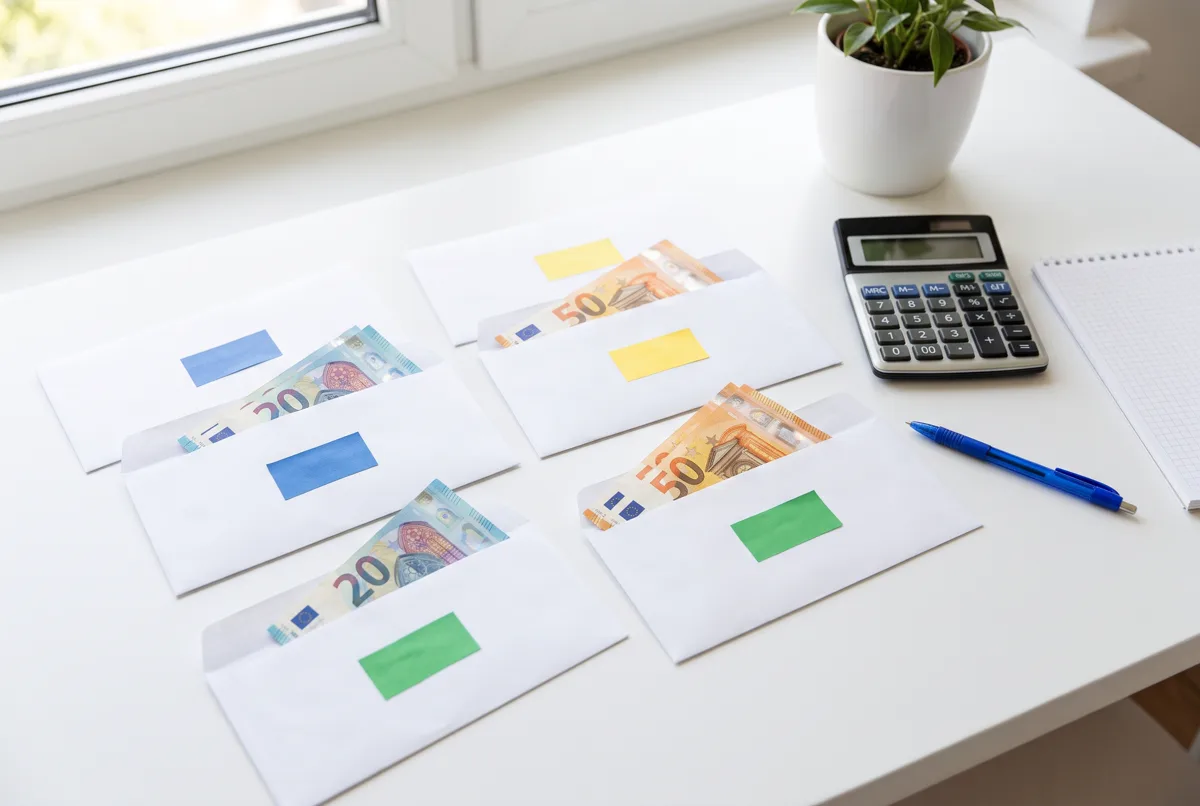
A simple way to get organised is to divide your salary into blocks. Here is an indicative example for a person living alone in Spain who earns approximately 1,200 euros net a month. The figures vary a lot depending on the city, so take them only as a reference.

| Category | Approximate amount | Comment |
|---|---|---|
| Savings (first) | €60 | Automatic transfer on payday |
| Housing | €500 | Rent or a shared room |
| Utilities (electricity, water, gas, internet) | €110 | Varies with the time of year |
| Groceries and cleaning products | €220 | With a weekly menu and a list |
| Transport | €50 | Monthly public transport pass |
| Phone | €15 | Basic plan with no minimum contract |
| Clothes, toiletries and pharmacy | €60 | Monthly average |
| Leisure and treats | €80 | A fixed amount so you don't feel deprived |
| Unexpected and annual expenses | €105 | Insurance, gifts, repairs |
Notice two details: savings are on the first line, and leisure has its own slot. A budget with no room to enjoy yourself gets abandoned quickly. If you share a home or have children, you can see how to adapt it in this guide to making a monthly family budget in Spain.
Spread annual expenses across the year
Home insurance, the annual property tax (IBI) if you own your home, the roadworthiness test for your car (ITV) or Christmas gifts throw any month off balance. Add up what you pay per year for these items, divide it by twelve and set that amount aside every month, either in the same savings account or in a different one. That way, when the charge arrives, the money will already be there.
The expenses where cutting back makes the most difference
You don't need to cut everything. It is more effective to focus on the big expenses and the ones that repeat every month.
Supermarket shopping
This is the biggest variable expense in most households. What works best is planning the week's menu, making a list and shopping only once. It also helps to compare the price per kilo, choose supermarket own-brand products for basics and take advantage of seasonal fruit and vegetables. You'll find more ideas in the article on how to save on supermarket shopping in Spain.
Electricity and gas
- Check your contracted power: many homes pay for more power than they need.
- Compare whether a regulated-market tariff (PVPC, the voluntary price for small consumers) or a fixed-price tariff suits you better.
- Run the washing machine and dishwasher during the cheapest hours if your tariff has time bands.
- If your income is low, find out about the requirements for the electricity social discount (bono social eléctrico).
This guide to saving on your electricity bill in Spain explains it in more detail.
Phone, internet and subscriptions
Fibre and mobile rates have come down a lot, and there are basic options with no minimum contract for approximately 25 to 35 euros a month. Call your provider, compare offers and ask whether they can lower your price. Also review streaming services, music, apps and the gym: keep only the ones you really use, or alternate one each month.
Bank fees
Paying account maintenance or card fees is money lost for nothing in return. Many banks in Spain offer fee-free accounts if you have your salary paid into them. It is worth asking or switching banks.
Small expenses, habits and impulse purchases
Often the money doesn't go on big purchases, but on small expenses made out of tiredness, boredom or stress: ordering takeaway because you can't face cooking, buying something online late at night or going out for a drink to clear your head.

- The 48-hour rule: if you want something you don't need, wait two days before buying it. Often the urge passes.
- Delete saved cards from online shops. Having to type in the details puts a brake on impulse buying.
- Unsubscribe from promotional newsletters that land in your inbox.
- Keep an easy dinner ready in the freezer for the nights when you don't feel like cooking.
Having ways to relax at home without spending also helps you avoid those “I deserve it” purchases at the end of a long day.
If you are looking for ideas, here is a selection of stress-relief games that really help you relax, both on your phone and screen-free.
Simple tricks that add up by the end of the year
Once you have automatic saving up and running, you can boost it with small challenges:
- Adapted 52-week challenge: save 1 euro in the first week, 2 in the second and so on. If it gets hard towards the end of the year, do it in reverse, starting with the highest amount in January, when you have more motivation.
- Keep your coins: when you get home, drop your 1 and 2 euro coins into a piggy bank. After a few months you'll notice the difference.
- Sell what you don't use: clothes, small pieces of furniture, toys or gadgets stored away can be turned into cash on second-hand platforms.
- Save what you “save”: if you manage to cut your phone bill by 10 euros, transfer those 10 euros to savings instead of leaving them in your current account.
- Use cash for leisure: at the start of the month, withdraw the amount you have decided on for treats. When it's gone, it's gone.
To keep track of these challenges and your daily spending, you can use the app “Canvartin: Planner and Appointments,” which includes an expenses section and lets you print A4 planners from your phone, or a paper financial planner if you prefer to write by hand.
Emergency fund: how much and where to keep it
The first goal of your savings should be an emergency fund: money that is used only for real emergencies, such as a breakdown, an urgent repair or a month with less income.
- First goal: around 500 euros. It covers most small scares.
- Second goal: the equivalent of one month of basic expenses.
- Long-term goal: between three and six months of expenses, with no rush.
Keep it in a separate account that you can access quickly but don't use for everyday spending. Some savings accounts in Spain pay a small return; before signing up for any product, read the terms carefully and check that it has no fees or minimum commitment period. Avoid putting this money into products you don't understand or that could lose value.
When your fund is complete, you can start saving for specific goals, such as a trip, a deposit on a home or Christmas expenses, each in its own separate pot.
Frequently asked questions
How much should I save a month if I earn very little?
Start with what you can keep up without stress, for example 5% of your salary or a fixed sum of 20 or 30 euros. What matters is consistency; you can increase the amount later.
Is it better to save at the start or at the end of the month?
At the start. If you wait for something to be left over, the usual result is that nothing is. Setting up a transfer for payday is the simplest way to stick to it.
What should I do with extra salary payments?
Decide where they will go before you receive them. A balanced option is to put half towards savings or annual expenses and use the rest for whatever you need or fancy.
How can I save money if I have debts?
First build a small cushion of a few hundred euros so that unexpected costs don't create new debts. After that, put everything you can towards paying off the debt with the highest interest rate first.
Where should I keep the money I save?
In an account separate from the one you use every day, with no fees and no card attached. That way it is available for emergencies but out of sight.
What if I can't save anything one month?
Don't worry. Look at what happened, adjust your budget if needed and pick it up again the following month. One bad month doesn't cancel out the habit.