
How much electricity does a home air conditioner use in Spain? As a guide, a normal-sized inverter split unit typically uses approximately 0.4 to 1 kWh for every hour of use once the room is already cool. If you run it for about 6 hours a day over a summer month, that can add up to approximately 70 to 180 kWh, which is roughly 12 to 45 euros a month on the energy part of your bill, depending on your tariff and your unit.
These figures are approximate, as of the publication date, and they vary a lot from one home to another: an interior apartment in Bilbao does not use the same as a south-facing penthouse in Seville. So rather than settling for one number, it is better to learn how to work out your own.
In this article you will see how to do that calculation with the details of your own unit, a table with examples in euros and a list of simple changes to spend less without suffering in the heat.
Air conditioning: how much it really uses
The question of how much an air conditioner uses has a catch, because the unit does not use the same amount all the time. It works in two phases:
- Start-up: when you switch it on in a hot home, it works at almost full power until it gets close to the temperature you have chosen. This is when it uses the most.
- Maintenance: if it is an inverter model, it then slows down and only works as much as needed to hold the temperature. Here the consumption can drop to half or less.
That is why two people with the same model can have very different bills. The hours of use, the temperature you set, the insulation, the orientation of the home and, of course, the price per kWh on your tariff all make a difference.
Frigorías (cooling capacity) and watts: not the same thing
In the shop you will hear about frigorías, the cooling-capacity unit traditionally used in Spain (for example, 2,500 or 3,000 frigorías). This tells you how much cooling the unit can produce, not how much electricity it uses. To find out the electricity consumption you need to look for the absorbed power, or cooling power input, which is given in watts (W) or kilowatts (kW). An efficient unit produces a lot of cooling while using little electricity.
How to calculate what your unit uses
Where to find the details
- Look for the energy label or the rating plate, which is usually on the side of the indoor or outdoor unit.
- Check the instruction manual, which gives the absorbed power in cooling mode.
- On the European energy label you will also see an estimated annual consumption in kWh, calculated for standard conditions of use. It is useful for comparing models, not for predicting your exact bill.
The simple formula
For a rough home estimate:
Monthly consumption (kWh) = average power (kW) × hours per day × days of use
Approximate cost (€) = monthly consumption (kWh) × the price per kWh on your bill
Since the unit does not always work at maximum, a common-sense rule is to use between half and two thirds of the rated absorbed power as the average power if it is an inverter model. If it is an older unit or a portable one, it is better to assume something closer to the full power.
Example: an inverter split unit with 0.9 kW of absorbed power, used 6 hours a day for 30 days. Estimated average power: about 0.6 kW. Consumption: 0.6 × 6 × 30 = 108 kWh. With a price of, say, €0.18/kWh, that would be about 19 euros a month. The price per kWh is on your bill and varies depending on your electricity supplier and the type of tariff.
Approximate table of monthly consumption and cost
These examples use an energy price of approximately €0.15 to €0.25/kWh, as of the publication date. They only include the energy part; the power charge and the taxes on your bill are separate.
| Situation | Average consumption per hour | Use | kWh per month (approx.) | Cost per month (approx.) |
|---|---|---|---|---|
| Bedroom, small inverter split | 0.4 kWh | 4 h a day | 48 kWh | €7-12 |
| Living room, medium inverter split | 0.7 kWh | 6 h a day | 126 kWh | €19-32 |
| Portable unit | 1 kWh | 6 h a day | 180 kWh | €27-45 |
| Heavy use, heatwave | 1 kWh | 8 h a day | 240 kWh | €36-60 |
To get an idea of how much this weighs on your bill, it can help to compare it with how many kWh a home uses per month in Spain. In many households, air conditioning is what makes the July and August bills rise noticeably.
If you like to keep these figures in sight, noting down the kWh and the bill amount each month lets you compare one summer with another and see whether your changes make a difference.
What makes it use more or less
- The chosen temperature: every extra degree of cooling you ask for makes it work harder. It is one of the factors with the biggest influence.
- Inverter or not: inverter units adjust their power; older ones switch on and off at full blast, which usually uses more.
- The right size: a small unit in a large living room will always work at maximum; one that is too big runs short, inefficient cycles.
- Insulation and orientation: windows without an awning that get afternoon sun, top-floor ceilings under the roof or poorly insulated walls mean more cooling is needed.
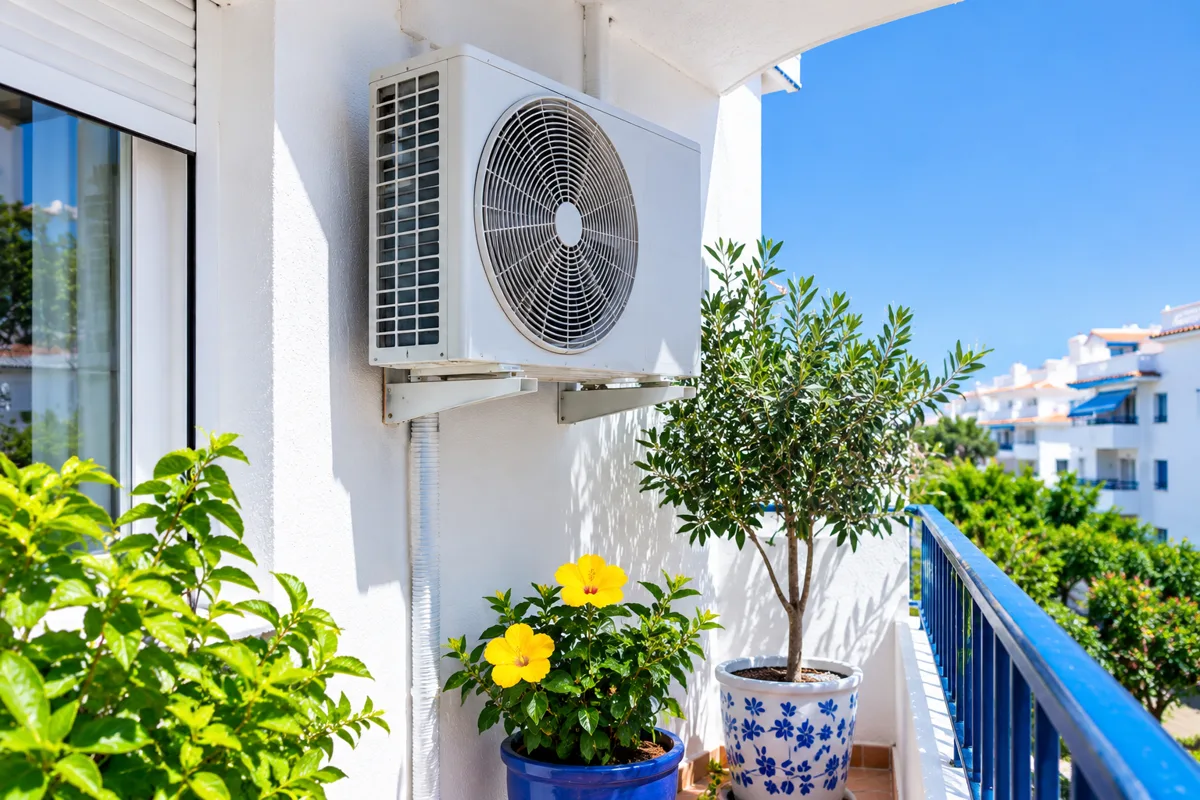
- Maintenance: dirty filters, or an outdoor unit in full sun and surrounded by clutter, reduce performance.
- Portable units: they tend to be less efficient than a split, because some of the hot air comes back in through the hose or the gap in the window.
How to use less with your air conditioner
You do not have to give up on staying cool. These changes are simple and, added together, can reduce consumption, although the result depends on each home:
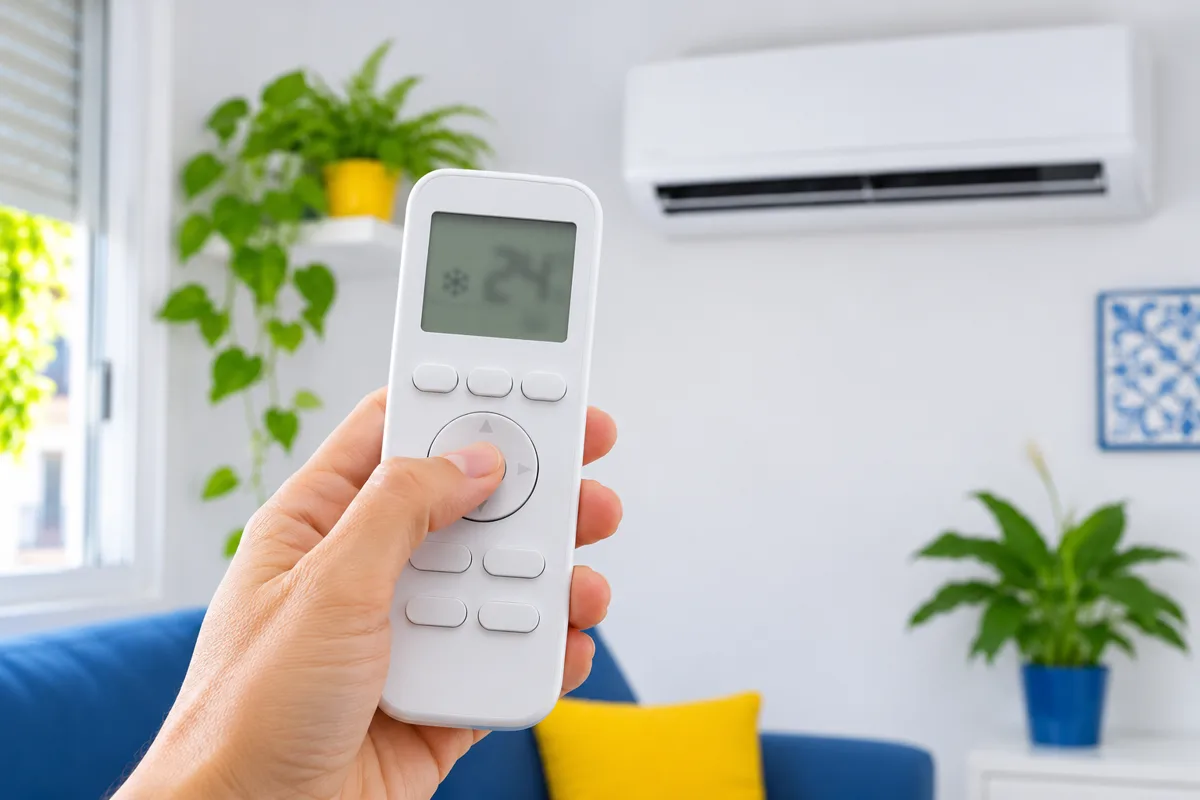
- Choose a reasonable temperature. Between 24 and 26 °C is usually comfortable for most people. You can read more in what temperature to set your air conditioner to in Spain to spend less.
- Avoid dropping the temperature all at once. Setting 18 °C does not cool faster; it only makes the unit keep working harder when the room is already cool.
- Close doors and windows. Cool only the room you are in.
- Lower the blinds and awnings during the sunny hours. In Spain, especially on façades that get afternoon sun, this makes a difference.
- Air the house at night or first thing in the morning. Open up when it is cooler outside than inside and close before the temperature rises.
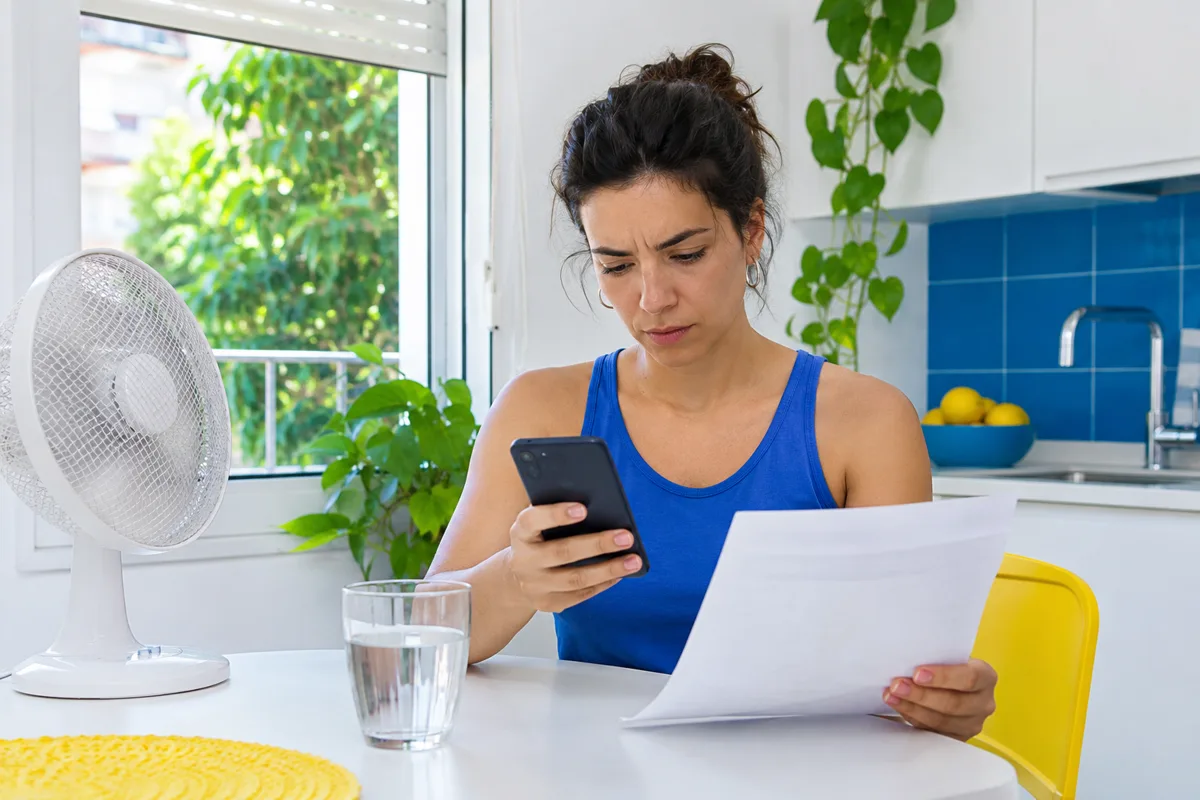
- Combine it with a fan. Moving the air makes you feel cooler with the thermostat one or two degrees higher. A fan uses very little, as you will see in how much a ceiling fan uses in Spain.
- Clean the filters. Check the manual; during the season of use, looking at them every few weeks is a good habit.
- Use the timer. Having it switch off by itself in the early hours or when you leave the house avoids pointless hours of running.
- Try dehumidify mode on humid days. In coastal areas, removing humidity alone makes the air feel more pleasant.
Being hot is also tiring and puts you in a bad mood, so it is worth creating a quiet moment in the coolest room of the house, with the blind down and something that helps you switch off.
Time slots, tariff and contracted power in Spain
Time bands
In Spain, many household tariffs have different prices depending on the time of day: peak, standard and off-peak (called punta, llano and valle). In general terms, off-peak usually coincides with the night and weekends, and peak with some hours of the morning and evening on working days. The exact times and prices depend on your contract, so check your bill or ask your electricity supplier before rearranging anything.
If your tariff has time bands, it may be worth cooling the bedroom a while before going to bed or using the air conditioning more at the weekend, instead of running it flat out during the most expensive hour.
Contracted power
If the power limiter trips when you switch on the air conditioning together with the oven or the washing machine, you may be at the limit of your contracted power (the maximum power your contract allows you to draw at once). Increasing it carries a fixed monthly cost, so before changing it try spreading out the use of your appliances. For any change, ask your electricity supplier about the conditions and prices.
If you want to review your whole bill, not just the air conditioning, you will find more ideas in how to save on your electricity bill in Spain.
How to keep summer spending under control in your budget
Summer bills are less frightening when you see them coming. Some practical ideas:
- Look at last year's July and August bills. They give you a real reference for how much your electricity goes up with the air conditioning.
- Set aside an extra amount for those months. Putting a little aside in spring avoids a sudden shock.
- Note down the meter reading. If you write down the kWh every week, you will quickly see the effect of setting one degree higher or lowering the blinds.
- Review your spending at the end of summer. That way you can decide with data whether it is worth replacing an old unit or improving awnings and windows.
If you keep your accounts on your phone, in the Canvartin: Planner and Appointments app you can note down your electricity expenses and set a reminder to read the meter. And to fit it all into the month, the guide on how to make a monthly household budget in Spain may help.
Frequently asked questions
How much does a 3,000 frigorías air conditioner use?
It depends on its efficiency, but an inverter split unit of that size typically has an absorbed power of approximately 0.8 to 1.2 kW. With normal use, the average consumption per hour is usually lower than that once the temperature has been reached.
Is it better to leave it on all day or switch it off?
If you are out for a few hours, it usually pays to switch it off or put it on a timer. If you are only away for a short while in the middle of the heat, turning it on and off repeatedly may save nothing. The sensible approach is to use the timer according to your routine.
Does a portable air conditioner use more than a split one?
In general, yes: portable units tend to be less efficient and cool the room less well. For a specific room and occasional use they can do the job, but it is worth checking their absorbed power before buying.
Does the fan mode of an air conditioner use a lot?
Not much: in that mode only the indoor fan runs and the compressor stays off, so the consumption is much lower than in cooling mode.
How can I find out exactly how much my air conditioner uses?
The most reliable way is a plug-in energy meter, if the unit plugs into a socket, or comparing the meter reading with and without the air conditioning on over the same period of time. The energy label gives you a useful estimate for comparing models.