
If you are wondering how much money to give at a wedding in Spain, the most common rule of thumb is this: at the very least, the cost of your plate at the banquet, and more the closer you are to the couple. At the time of publication, that usually works out at approximately 100-150 € per person if you are a friend or a not-so-close relative, and quite a bit more if you are a sister, a wedding sponsor or a close friend.
There is no official figure and no written rule: it is a custom, and it changes depending on the region, the type of wedding and each family's finances. What does exist is a certain social consensus that is worth knowing, so you don't fall short or stretch further than your budget can handle.
In this article you will find a guideline table by closeness, the most common customs in Spain for handing over the money, and a simple way to organize yourself so the wedding doesn't throw off your month.
The "cover your plate" rule: where the figure comes from
In Spain, the idea has spread that a cash gift should at least "cover your plate", meaning what the couple pays the restaurant or the venue for each guest. It is a way of making sure the celebration doesn't cost them money for having invited you.
The price per plate varies a lot. As a guide, at the time of publication it is usually approximately between 80 and 150 € per person, and it can go above that in big cities, at exclusive country estates (venues known in Spain as fincas) or in high season (from May to October, especially on Saturdays). In rural areas or for weekday weddings it can be somewhat lower.
Since you usually don't know how much they have actually paid, the practical approach is to look at the type of celebration:
- Simple wedding, at a restaurant or with a short menu: the price per plate is usually at the low end of the range.
- Wedding at a country estate or hotel, with a cocktail hour, banquet and open bar: it is usually in the middle or upper part of the range.
- Multi-day wedding or one in another city: the couple usually take on more costs, but so do you (travel, accommodation), and that is taken into account.
How much to give at a wedding depending on how close you are
How close you are to the couple is what changes the amount the most. These figures are guidelines, at the time of publication, and may vary depending on the region and each family's customs:

| Relationship to the couple | Per person (approx.) | Per couple (approx.) |
|---|---|---|
| Work colleagues, acquaintances | 80-120 € | 150-220 € |
| Friends and less close family | 100-150 € | 200-300 € |
| Close friends | 150-200 € | 300-400 € |
| Close family (aunts and uncles, very close cousins) | 150-250 € | 300-500 € |
| Siblings, wedding sponsors | Variable | 400 € or more |
| Guests who don't attend | Optional | 50-100 € or a small gift |
Work colleagues and acquaintances
Here the idea is usually to cover your plate without big extras. If several colleagues are invited, the money is sometimes pooled into a single gift, which is tidier.
Friends and less direct family
This is the most common bracket. Covering your plate and adding a little on top is the usual approach, especially if it is a full wedding (ceremony, cocktail hour, banquet and party).
Close friends and close family
When the relationship is close, many people give a bit more as a gesture of affection. It isn't compulsory, but it is the most widespread custom.
Siblings, wedding sponsors and parents
In this circle there is usually no reference figure. Parents often contribute to part of the wedding costs, and siblings and wedding sponsors (in Spain, the people who accompany the couple at the ceremony, usually parents or close relatives) tend to give a bigger gift or help with something specific (the flowers, the honeymoon, the dress). It depends a lot on each family.
Other factors that change the amount
Besides closeness, there are details that push the figure up or down:
- Whether you go alone, as a couple or with children. It is calculated per adult. For children, many families add a smaller amount, because their menu usually costs less.
- Whether the wedding is outside your city. If you have to pay for travel and a hotel, it is quite common to adjust the amount a little. The couple usually understand.
- Costs beforehand. Hen party (bachelorette party), outfit, hairdresser, transport: it all adds up. If you are the one organizing the hen party, count it as part of the wedding budget.
- Whether the couple invited you before, or you invited them. Many people try to give a similar amount to what they received, adjusted for the time that has passed.
- Your financial situation. It is a gift, not a fee. A more modest amount given with affection is perfectly fine.
Customs in Spain for giving the money
In Spain, giving money at a wedding is completely normal, and these are the most common ways to do it:
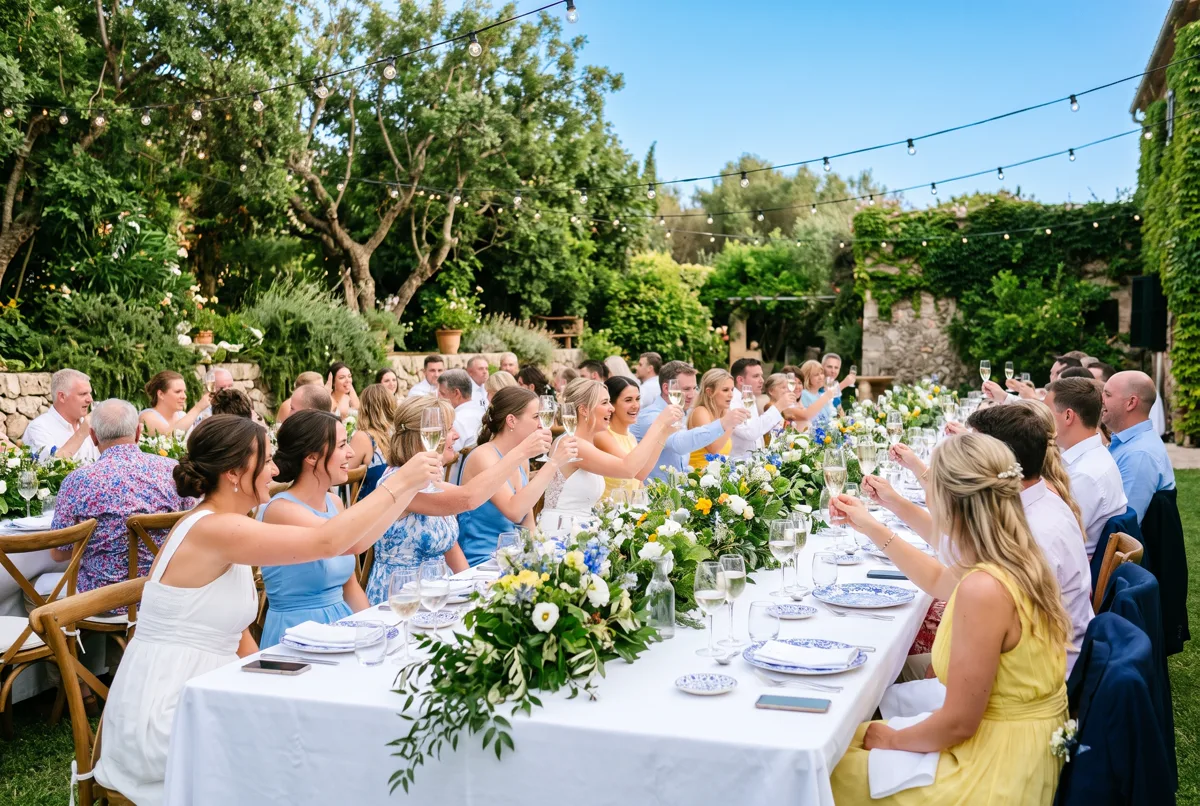
- Bank transfer to the account on the invitation. More and more couples include a bank account number on the invitation or on the wedding website. It isn't considered tacky: it is practical for everyone. It is usually done a few days or weeks before the wedding, putting your name in the payment reference.
- Envelope on the day. It is still common, especially among older relatives. It is usually handed over during the banquet or placed in a box prepared for the purpose. If you go for cash, withdraw it in good time and check how much money you can withdraw from an ATM per day, which may depend on your bank and your card.
- Gift registry or a specific gift. Less common than it used to be, but some couples prefer it. If you choose this option, you can use the same amounts as a guide.
- Contribution to the honeymoon. Some couples set it up this way; in practice it works the same as a transfer.
One detail that is usually appreciated: accompany the money with a handwritten card. It costs nothing and it is what people really remember.
If you have several weddings this year, it can help to note each one with its date and amount in a single place, as you would with any big expense of the year.
How to fit a wedding into your budget
A wedding can cost you quite a bit more than the gift. So it doesn't catch you by surprise, it is best to treat it as a planned expense rather than an unexpected one:
- Work out the real total. Add up the gift, outfit, hairdresser, transport, accommodation and hen party. Often the total comes close to double what you had planned to give.
- Divide it by the months you have left. If the wedding is in six months and you expect to spend 600 €, setting aside approximately 100 € a month is easier than paying everything at once.
- Set it aside in its own category. Within your monthly household budget, create a "celebrations" line for weddings, communions and birthdays.
- Treat it as a variable expense. Weddings don't come around every month, so they fit better among your variable household expenses, with a yearly forecast.
- Check the clothes you already have. Re-wearing a dress with different accessories is a simple way to bring down the total.
If you keep track of your finances on your phone, the app Canvartin: Agenda and Appointments lets you note the wedding date in the calendar, add a reminder to make the transfer and record the expense; if you prefer paper, our handmade financial planners made in Spain also work well for keeping this category separate.
What to do if you can't reach that amount
It happens more than it seems, especially in seasons with several weddings in a row. Some ideas:

- Give what you can without over-apologizing. A somewhat smaller amount is usually not a problem if you add a thoughtful touch.
- Pool the gift with other people. A joint gift from several friends lets you give something more impressive without each person putting in as much.
- Offer your help. If you have a useful skill (decoration, photography, organization), some couples value it as much as money, as long as you talk about it beforehand.
- Consider not attending if you truly can't afford it. It is better to let them know in good time and send a small gift than to go into debt. If you want to build up some breathing room for future celebrations, these ideas for saving money every month even on a low income may help.
Talking about money with friends is tiring, and between the budget, the outfit and the logistics, it is normal to end up with your head overloaded before the wedding.
If you are the one getting married
Knowing these customs is also useful if you are on the other side. Some practical recommendations:
- Don't count on recovering all of the cost. What you receive varies a lot from one wedding to another; plan your budget around what the two of you can pay yourselves.
- If you include a bank account number, do it discreetly. A simple sentence on the invitation or on the website is enough.
- Thank everyone equally. A thank-you note after the wedding is a much appreciated gesture, whatever the amount received.
If you are in the middle of organizing, here is a guide to planning a wedding in Spain with a calendar and a budget.
Frequently asked questions
How much money do you give at a wedding in Spain if you go as a couple?
As a guide, at the time of publication, approximately 200-300 € if you are friends or not-so-close family, and 300-500 € if the relationship is very close. It depends on the region and the type of wedding.
Is it rude to put a bank account number on the invitation?
In Spain it is a very widespread and accepted practice. It is usually done discreetly, with a short sentence.
When do you make the transfer, before or after the wedding?
The most common approach is to make it a few days or weeks before. After the wedding is also accepted, but it is best not to let too much time pass.
Do you have to give money if you don't go to the wedding?
It isn't compulsory. If you have a close relationship with the couple, many people send a small gift or a symbolic amount.
How much do you give for a child who is invited?
There is no fixed figure. Many families add a smaller amount than for an adult, because the children's menu usually costs less.
Do you give less if the wedding is in another city?
It is quite common to adjust the amount a little when you have to pay for travel and accommodation. The couple usually take this into account.