
A budget-friendly weekly family meal plan rests on three things: legumes, rice, pasta, eggs and seasonal vegetables as the base, meat and fish in moderate amounts, and a single well-planned big shop. With a plan for lunches and dinners for seven days and a fixed shopping list, a family of four in Spain can get organised without improvising every afternoon, and with fewer trips to the supermarket.
In this article you will find a ready-made weekly meal plan for the family, with simple, traditional dishes, a shopping list grouped by section and an approximate budget. You will also see how to cook it easily and quickly, and how to adapt it to your home, your schedule and the time of year.
The idea is not to follow it to the letter, but to give you a starting point. Change it, drop what you don't like and repeat what works: a weekly family meal plan only really works when it looks like what you already eat.
How to plan a budget-friendly family menu
Before copying any menu, it helps to be clear on a few principles. They are what make the plan cheap week after week, and not just once.
- Legumes two or three times a week. Lentils and chickpeas are among the cheapest foods around and very filling. Dried ones cost less; jarred ones save time.
- Grains as the base: rice, pasta, thin noodles and bread. They go with almost anything and stretch the portions.
- Eggs as the all-purpose protein. Omelette, scrambled eggs, hard-boiled eggs: they sort out dinner in ten minutes.
- Meat in cheaper cuts: chicken thighs, whole chicken, mixed minced (ground) meat. Better than individual steaks or fillets.
- Frozen fish. Hake, pollock or similar in a bag is usually cheaper than fresh and doesn't spoil.
- Seasonal vegetables and fruit. In Spain, autumn and winter bring plenty of pumpkin, cabbages, leeks and citrus; spring and summer bring courgettes (zucchini), tomatoes, peppers and stone fruit.
- Dishes that get reused: what is left over from one meal becomes the next dinner or goes in the freezer.
Keep in mind Spanish mealtimes too: the usual pattern is a more substantial lunch at midday and a lighter dinner around nine in the evening. That is why the dinners in the plan below are quicker.
Weekly family meal plan: a 7-day example
This example is designed for two adults and two school-age children. If there are more or fewer of you at home, adjust the quantities in the list. For dessert, seasonal fruit or a yoghurt; for bread, whatever you usually eat.

| Day | Lunch | Dinner |
|---|---|---|
| Monday | Lentils with vegetables (carrot, potato and pepper) | Plain omelette with tomato salad |
| Tuesday | Rice with chicken and vegetables | Courgette (zucchini) cream soup with fresh cheese and croutons |
| Wednesday | Macaroni with tomato sauce and tuna | Baked hake with sliced roast potatoes |
| Thursday | Chickpeas with spinach and a hard-boiled egg | Scrambled eggs with mushrooms and toast |
| Friday | Roast chicken with potatoes and onion | Homemade pizza with whatever is in the fridge |
| Saturday | Meatballs in tomato sauce with white rice | Spanish potato omelette (tortilla de patatas) and green salad |
| Sunday | Thin noodles with vegetables and minced (ground) meat | Soup made with the week's broth and chopped egg |
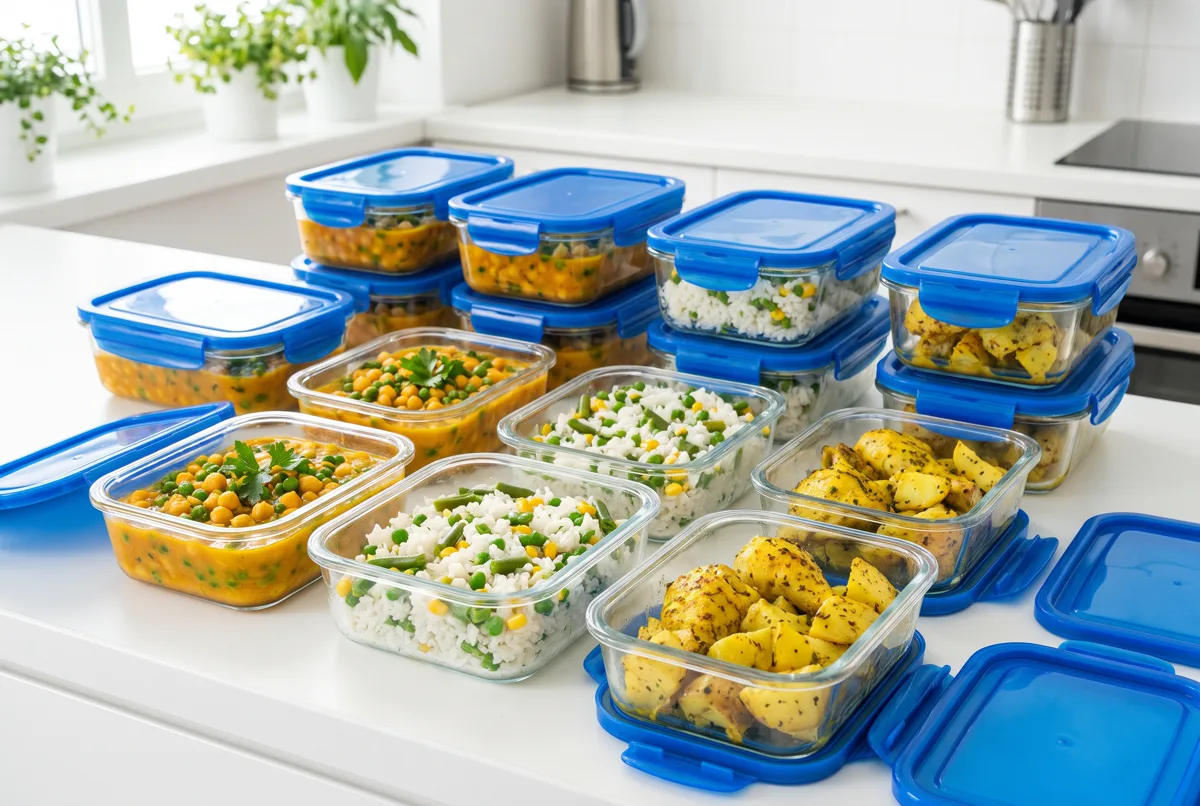
Notice how the dishes link together: the chicken on Tuesday and on Friday comes from the same purchase, the minced meat covers both the meatballs and the Sunday noodles, and the vegetables repeat across several recipes so nothing is left over. If you have lentils left over from Monday, you can freeze them; here is how long cooked lentils last in the fridge so you can decide in time.
Having this plan in plain sight, on the fridge door, means nobody asks every afternoon what's for dinner.
If you prefer to organise it from your phone, the Canvartin: Planner and Appointments app lets you print an A4 planner, blank or already filled in with your details, so you can keep it on paper in the kitchen.
Shopping list for this weekly family meal plan
The quantities are approximate for four people. Check your pantry first and cross off what you already have: it is the step that saves the most money.
Pantry
- Lentils: 500 g
- Chickpeas: 500 g dried or 2 large jars
- Rice: 1 kg
- Macaroni: 500 g
- Thin noodles: 500 g
- Crushed tomatoes: 2 or 3 jars or cartons
- Canned tuna: 3 or 4 cans
- Flour and baker's yeast (for the pizza), if you don't have them
- Olive oil, salt, spices and stock cubes or broth, depending on what you have left
Meat, fish and eggs
- Chicken: one whole chicken cut into pieces or about 1.5 kg of thighs
- Mixed minced (ground) meat: 600 to 700 g
- Frozen hake or other white fish: 600 to 800 g
- Eggs: 2 dozen
Fruit and vegetables
- Potatoes: 2 to 3 kg
- Onions: 1.5 kg
- Carrots: 1 kg
- Courgettes (zucchini): 3
- Peppers: 2
- Tomatoes: 1 kg
- Lettuce: 2
- Mushrooms: 300 to 400 g
- Frozen spinach: 400 g
- Garlic: 1 head
- Seasonal fruit: 3 to 4 kg
Dairy and other items
- Milk and yoghurts, depending on what you use
- Fresh cheese and grated cheese for the pizza
- Fresh bread of the day or bread to freeze
How much a budget-friendly weekly family meal plan costs
With this list, and at the time of publication, the shopping for lunches and dinners for four people can come to roughly 70 to 110 euros a week. If you add breakfasts, snacks and cleaning products, the figure goes up. It is only a reference: prices vary a lot depending on the area of Spain, the type of shop, the time of year and the brands you choose.
To find out what you really spend, keep the receipt from each week for a month. With that real figure you can see what share of your income goes on food and fit it into a monthly family budget without surprises.
- Add up the receipts from four weeks.
- Divide by four to get the weekly average.
- Mark which products come up again and again and which ones were thrown away unused.
- Adjust next week's list using that information.
While the lentils are cooking or you are peeling potatoes for the omelette, the kitchen can be a calm moment instead of a race against the clock.
And if you like that feeling of small tasks and calm sounds, the game Canvartin: Home Simulator for iPhone recreates things like peeling potatoes or washing dishes so you can switch off for a while.
How to cook the meal plan easily
An easy family meal plan doesn't depend only on the recipes, but on how you split up the work. Spending an hour or two on Sunday makes a big difference to the rest of the week.
What is worth getting done at the weekend
- Cook the lentils and chickpeas (or have the jars ready).
- Make a big batch of sofrito (a base of slowly fried onion, pepper and tomato) and store it in portions.
- Hard-boil a few eggs for salads and chickpeas.
- Wash and chop vegetables you will use in the first few days.
- Make broth with the chicken bones for the following Sunday's soup.
If you want to go further and have several complete dishes ready, in this article on weekly batch cooking you will find a step-by-step method.
During the week
- Cook double when the dish allows it: half for today and the other half for the freezer.
- Make the most of the oven: if you roast the chicken, put the potatoes or some vegetables in at the same time.
- Keep dinners for ten or fifteen minute dishes: omelettes, scrambled eggs, ready-made soups.
- Ask for help: children can wash the lettuce, set the table or beat eggs.
Tricks to make the meal plan cheaper
The plan is already economical in itself, but these habits make a difference over the month.

- Shop once a week with a fixed list. Every extra visit tends to bring home something that wasn't planned.
- Compare the price per kilo, not the price of the pack. It is on the shelf label.
- Try the store brand for basics such as rice, pasta, legumes or crushed tomatoes.
- Use your local market for seasonal fruit and vegetables, especially near closing time.
- Freeze in portions bread, minced (ground) meat and whatever is left over.
- Have an “empty the fridge” day: Friday's pizza is made for exactly that.
To make what you buy last, it helps a lot to know how to organise your fridge so food lasts longer. And if you want more ideas for the receipt, here are tips for saving on your supermarket shop in Spain.
How to adapt the meal plan to your family
Every home has its own tastes, schedules and budgets. These simple adjustments let you reuse the same structure all year round.
- In summer: swap the courgette (zucchini) cream soup for gazpacho or salmorejo (a thicker chilled tomato soup), the lentils for a lentil salad, and the oven for the frying pan or griddle.
- In winter: add one more hearty pulse stew or broth, and use pumpkin, leek or cauliflower in the cream soups.
- If the children eat at the school canteen: ask for the school menu and plan dinner as a complement, without repeating what they ate at lunchtime.
- If you get home late: keep the long-cooking meals for the weekend and save the already cooked dishes for weekdays.
- If there are more of you: increase mainly legumes, rice, pasta and potatoes, which stretch the most without sending the cost soaring.
If anyone at home has allergies, intolerances or special dietary needs, check with a healthcare professional before making any major change to the diet.
Frequently asked questions
How much does a weekly meal plan for a family of four cost in Spain?
With a plan based on legumes, grains, eggs and seasonal vegetables, lunches and dinners can come to roughly 70 to 110 euros a week, at the time of publication. It depends on the area, the shop and what you already have at home.
How do I make an easy family meal plan if I work late?
Cook the most time-consuming dishes at the weekend and keep quick dishes for weekdays: omelettes, scrambled eggs, ready-made soups or frozen portions that only need heating.
Can the food in the meal plan be frozen?
Most of it can: stewed legumes, meatballs in sauce, broths, cream soups and raw minced (ground) meat all freeze well. Boiled potato and salad don't usually turn out the same after thawing.
What do I do if the children don't like a dish?
Change the presentation before the ingredient: lentils blended into a soup, vegetables hidden in an omelette or in the pasta sauce base. Letting them choose one dish of the week also helps.
How often should I change the meal plan?
Many families rotate three or four weekly plans and repeat them. That way the shopping list almost writes itself and it is easier to keep track of spending.